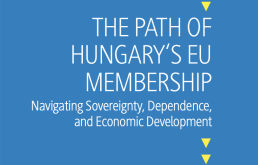
This book examines the impact of European Union membership in Hungary over the past two decades. It explores how successive Hungarian governments have either leveraged or failed to capitalize on the opportunities provided by the EU framework. Through a detailed analysis of various policy areas—including monetary and fiscal policy, regional policy, industrial policy, social policy and agricultural policy—the volume evaluates how EU regulatory influences have intersected with domestic policies to shape Hungary's development trajectory.
The book highlights both the boundaries of EU influence and the constraints of domestic political and economic agency in a small, open economy grappling with the challenges of dependent development. This book will appeal to students, researchers, and policymakers in the fields of political economy, European studies, and public policy.
The book is fully OPEN ACCESS. Download it here.
Recommendations:
“In this pivotal volume, András Bíró-Nagy and Gergő Medve-Bálint bring together a distinguished group of Hungarian scholars to examine how Viktor Orbán has navigated the tensions between his political illiberalism and Hungary’s economic dependence within the European Union.” — Professor Tanja Börzel, Director of the Center for European Integration, Freie Universität Berlin, Germany
“This highly informative book offers a much-needed analysis of the political economy of Hungary’s EU membership. The volume is a must read for anyone interested in Hungary’s trajectory over the past 20 years, and the conflicts shaping European integration today.” — Professor Dorothee Bohle, University of Vienna, Austria
Editors: András Bíró-Nagy and Gergő Medve-Bálint
Publisher: Palgrave Macmillan
Policy Solutions is a progressive political research institute based in Budapest. It was founded in 2008 and it is committed to the values of liberal democracy, solidarity, equal opportunity, sustainability and European integration. The focus of Policy Solutions’ work is on understanding political processes in Hungary and the European Union. Among the pre-eminent areas of our research are the investigation of how the quality of democracy evolves, the analysis of factors driving euroscepticism, populism and the far-right, and election research.
Follow us on Facebook!